Thank God I live in Canada! Right now, I'm truly grateful for the intelligent leadership our government is providing. Say what you will about Justin Trudeau but I appreciate his daily briefings, followed by the press conference with his ministers. Over the past few weeks we have become better acquainted with some of the top players in his cabinet, along with the medical officers of health in all the provinces. I'm grateful that Trudeau and his team are acknowledging and following the advice of Canada's top doctors and scientists.
We even have cooperation between provincial premiers and the federal team - something that would have been unheard of, just a couple of months ago. Yesterday in the National Post, there was an article about how Ontario's Premier, Doug Ford, has risen to the occasion. Click here, Ford Draws Praise from Friends and Foes.
It was Thursday, March the 12th, when Ford changed his tune. In the morning, Ford appeared at a press conference, telling Ontario families, " Go away, have a good time, enjoy yourselves."
Only a few hours later his government announced the drastic step of extending March break for two extra weeks. Finally, the reality of the situation had sunk in, as Ford and his team listened to the advice of scientists and public health officials. Over the past couple of weeks we've seen a new Ford, as described in The National Post:
"Gone is the pugnacious partisanship and populist rhetoric that opponents once used to compare Ford to U.S. president Donald Trump. The premier's regular briefings have instead drawn widespread plaudits for their calm collegial tone, as well as their comparatively progressive content."
When I look at the "leadership" on display in the U.S. and the disjointed efforts by various states, I feel even more grateful that our politicians here in Canada have managed to put aside their political differences and work together for our common good. At today's news conference, goodwill was on display again, as Quebec's premier thanked Doug Ford and Trudeau and his team.
Recently I read Michelle Obama's book, Becoming. I really enjoyed her observations on President Obama's role. Unfortunately, it is all in very sharp contrast to the current administration.
"Nighttime was when Barrack's mind travelled without distraction. It was during these quiet hours that he could find perspective, inhale new information, adding data points to the vast mental map he carried around. Ushers often came to the Treaty Room a few times over the course of an evening to deliver more folders, containing more papers generated by staffers who were working late in the offices downstairs....Most nights of the week he stayed at his desk until 1:00 or 2:00 in the morning reading memos, rewriting speeches and responding to email....I was used to it now - his devotion to the never-finished task of governing. For years, the girls and I had shared Barrack with his constituents and now there were more than 300 million of them. Leaving him alone in the Treaty Room at night, I wondered sometimes if they had any sense of how lucky they were."
"When you're married to the president you come to understand quickly that the world brims with chaos, that disasters unfurl without notice. Forces seen and unseen stand ready to tear into whatever calm you might feel....His job, it seemed was to take the chaos and metabolize it somehow into calm leadership, everyday of the week, every week of the year.....How Barrack and I comported ourselves in the face of instability mattered.We understood that we represented the nation and were obligated to step forward and be present when there was a tragedy, or hardship or confusion. Part of our role, as we understood it, was to model reason, compassion and consistency."
In these regular morning appearances, Trudeau is doing just that. He is modelling reason, compassion and consistency. Thank you Prime Minister.
Tuesday, 31 March 2020

Thursday, 26 March 2020
Our New Era
So I last wrote here on January 29th...a totally different era. I keep wanting to ask, What the heck happened to our everyday lives? Some days, when I wake up, just for a second, I think we are back in the old days. Back then, I used to lie in bed and do a mental run-through of my activities for the day...go here and there, attend to tasks around the house, grocery shop, see family or friends. When I go to bed at night, same thing; I used to glance at the calendar just before going to bed, to remind myself of my commitments for the following day. Of course, all the items on the calendar have now been stroked out. There is no one to see and no place we should go. Old habits die hard. This complete change of lifestyle has happened so rapidly that I'm still adjusting my thinking.
That's part of the stress; the mental adjustments we have all had to make. Like many, I didn't grasp the reality of the situation very quickly. I didn't fully understand or acknowledge the warning signs. Bear with me...For the record, I'll try to make some sense of this past while.
Luckily for us, we have enjoyed a lot of family time over the past couple of months. We spent a week in Florida with baby Lauren, our newest grandchild, and her tired parents. It was lovely to bask in warm weather and I understand those who were reluctant to abandon their southern holiday plans. We returned on February 11th. I don't remember being concerned about the coronavirus then. It was something on the other side of the world, like when there is an earthquake in eastern Europe. It doesn't affect you. A few days after our return, we spent the family day weekend at Elmhirst's Resort (near Peterborough) with the rest of our kids and grandkids. It was our first time there and we enjoyed this family run resort. Their Sunday brunch is sensational.
The rest of February was spent participating in the kind of group activities that are now forbidden: lounging at an outdoor spa, visiting Parliament Hill for Question Period and a tour of the new Senate chambers, attending a birthday party, a funeral, book club and exercise classes. I even tried pickle ball.
By early March we were hearing more about the virus. That first weekend, we went to Toronto to visit our grandchildren before their March break trip to California. That was when everything started to go off the rails. Fortunately, Norah and Sean had the foresight to cancel their trip, scheduled for the 11th. I was upstairs and heard them telling the kids, at the breakfast table, that they would not be going to visit their cousins in L.A. I felt horrible as I listened to the kids cry.
That day, the 10th, I took the train back to Ottawa. The woman beside me used a disinfectant wipe on her armrest and tray table and offered me one. That was a wakeup call. Then came all the cancellations: the NBA, the NHL, community centres, all sports. On Thursday, the 12th, I did a lot of grocery shopping, not because of virus preparation but because Norah's family had decided to substitute our house for their California holiday. We were more than happy to welcome them home.
I sure wasn't thinking virus protection that day, as I went to several stores. Pat hit me with the big news when I returned. Ontario schools were closed for two weeks following the March break! That's when I knew it was serious. The cancellations kept piling up on the weekend: universities, libraries, concerts, restaurants, bars, museums, everything.
And yet I still didn't get it. Maybe I was just basking in having our family altogether that weekend. It was only on the night of the 17th, the day before she left, that Norah had to spell it out for me. It would probably be a long time before we saw each other again. That night, as we played board games, she had Choir Choir Choir on the laptop, leading a sing-a-long. When they sang Rainbow Connection it was all I could do, not to weep. What was happening?
The developments over these past two weeks have been head-spinning. Yesterday was Ontario's first day with only essential stores open. Our days and evenings are spent listening and watching CBC television and radio, even though this virus is the only item being covered. It's the only thing that matters anymore. It seems like we are all waging a war against this invisible killer that could be lurking anywhere.
And so we are here, inside. I feel extremely privileged, to be living in a house, in a safe neighbourhood, where I can go out for a walk. I do not have to teach or entertain young children all day long, although we did read some stories over FaceTime yesterday. We'll try to do that regularly. Parent of young children are putting in some pretty long days but what about the parents of teens? How hard must that be! What if our three kids, at university age, had suddenly all moved back in with us, without warning? How well would that have gone? There's nothing university-age kids like better, than spending time cooped up with mom and dad.
For the large families in small apartments, with no place to go, these days must be dreadful. So many of these parents are also, without warning, suddenly out of work. This morning, Davis Blair predicted on CBC radio that Canada's unemployment rate could be the highest in seventy years! If the situation is bad here in Canada, it is going to be much worse for the world's more vulnerable areas. Yesterday Stephen Lewis was on The Current, talking about how hard this will hit Africa.
So, from my place of privilege, I think it's only right to start thinking about how to help, in some small way. It's not possible to physically volunteer anywhere right now, but there are countless organizations, like The Ottawa Food Bank, that could really benefit from extra donations.
"There but for the grace of God, go I."
That's part of the stress; the mental adjustments we have all had to make. Like many, I didn't grasp the reality of the situation very quickly. I didn't fully understand or acknowledge the warning signs. Bear with me...For the record, I'll try to make some sense of this past while.
Luckily for us, we have enjoyed a lot of family time over the past couple of months. We spent a week in Florida with baby Lauren, our newest grandchild, and her tired parents. It was lovely to bask in warm weather and I understand those who were reluctant to abandon their southern holiday plans. We returned on February 11th. I don't remember being concerned about the coronavirus then. It was something on the other side of the world, like when there is an earthquake in eastern Europe. It doesn't affect you. A few days after our return, we spent the family day weekend at Elmhirst's Resort (near Peterborough) with the rest of our kids and grandkids. It was our first time there and we enjoyed this family run resort. Their Sunday brunch is sensational.
The rest of February was spent participating in the kind of group activities that are now forbidden: lounging at an outdoor spa, visiting Parliament Hill for Question Period and a tour of the new Senate chambers, attending a birthday party, a funeral, book club and exercise classes. I even tried pickle ball.
By early March we were hearing more about the virus. That first weekend, we went to Toronto to visit our grandchildren before their March break trip to California. That was when everything started to go off the rails. Fortunately, Norah and Sean had the foresight to cancel their trip, scheduled for the 11th. I was upstairs and heard them telling the kids, at the breakfast table, that they would not be going to visit their cousins in L.A. I felt horrible as I listened to the kids cry.
That day, the 10th, I took the train back to Ottawa. The woman beside me used a disinfectant wipe on her armrest and tray table and offered me one. That was a wakeup call. Then came all the cancellations: the NBA, the NHL, community centres, all sports. On Thursday, the 12th, I did a lot of grocery shopping, not because of virus preparation but because Norah's family had decided to substitute our house for their California holiday. We were more than happy to welcome them home.
I sure wasn't thinking virus protection that day, as I went to several stores. Pat hit me with the big news when I returned. Ontario schools were closed for two weeks following the March break! That's when I knew it was serious. The cancellations kept piling up on the weekend: universities, libraries, concerts, restaurants, bars, museums, everything.
And yet I still didn't get it. Maybe I was just basking in having our family altogether that weekend. It was only on the night of the 17th, the day before she left, that Norah had to spell it out for me. It would probably be a long time before we saw each other again. That night, as we played board games, she had Choir Choir Choir on the laptop, leading a sing-a-long. When they sang Rainbow Connection it was all I could do, not to weep. What was happening?
The developments over these past two weeks have been head-spinning. Yesterday was Ontario's first day with only essential stores open. Our days and evenings are spent listening and watching CBC television and radio, even though this virus is the only item being covered. It's the only thing that matters anymore. It seems like we are all waging a war against this invisible killer that could be lurking anywhere.
And so we are here, inside. I feel extremely privileged, to be living in a house, in a safe neighbourhood, where I can go out for a walk. I do not have to teach or entertain young children all day long, although we did read some stories over FaceTime yesterday. We'll try to do that regularly. Parent of young children are putting in some pretty long days but what about the parents of teens? How hard must that be! What if our three kids, at university age, had suddenly all moved back in with us, without warning? How well would that have gone? There's nothing university-age kids like better, than spending time cooped up with mom and dad.
For the large families in small apartments, with no place to go, these days must be dreadful. So many of these parents are also, without warning, suddenly out of work. This morning, Davis Blair predicted on CBC radio that Canada's unemployment rate could be the highest in seventy years! If the situation is bad here in Canada, it is going to be much worse for the world's more vulnerable areas. Yesterday Stephen Lewis was on The Current, talking about how hard this will hit Africa.
So, from my place of privilege, I think it's only right to start thinking about how to help, in some small way. It's not possible to physically volunteer anywhere right now, but there are countless organizations, like The Ottawa Food Bank, that could really benefit from extra donations.
"There but for the grace of God, go I."
Monday, 20 January 2020
Standing Up for Ontario Students
(Revised Jan. 29th)
Do retired teachers still care about issues affecting education? Absolutely! There is probably nothing more important than the education of our future citizens. Besides caring about society in general, I have a personal interest because of our grandchildren.
Imagine organizing your child's birthday party. Would you find it easier to entertain and keep track of 6 or 12 or maybe 18 little kids? Would you like to have 30 kids at that party? However, it's only a party. There are no learning objectives to pass along. There will be no assessment of their learning at the end of the party. All you have to do is entertain and feed them. Still, would you not find it easier to keep track of a dozen of them?
That teacher has 31 bodies in a classroom. With desks, chairs and equipment they hardly have any room to move. It's a combined grade. That teacher has to teach both the grade 4 and the grade 5 curricula. Sure, if the teacher had only 15, grade 5 students that would be a great class size. However, this teacher has to keep her grade 4 class engaged in meaningful tasks, while she teaches the grade 5 class. The age and ability spread in any split grade is often very wide. You may have students in the grade 4 class with learning disabilities who are barely reading and writing. At the same time there may be gifted grade 5 students who are functioning at a grade 8 level. Add to that, the students with various special needs. It would not be unusual to have a number of students with behaviour problems and some ESL kids. Ontario has welcomed many new Canadians in the past few years. How well are we serving their needs? There may be an autistic student, or others with hearing or visual impairments.
These strikes are about the quality of our schools, class size, the student/teacher ratio and the impersonal, inadequate nature of e-learning. These strikes are about the future of Ontario's society. We need more trained professionals (special education teachers, ESL teachers, psychologists, psychiatrists, occupational therapists, social workers, speech and language pathologists) in our schools, not less. E-learning cannot replace a caring knowledgeable teacher.
Education is not a simple business. It is a complicated, vital aspect of society. How Ontario's students emerge from high school will affect all of us, in countless ways. We need to take care of them while they are young, if we expect them to take care of us, when they are older.
Do retired teachers still care about issues affecting education? Absolutely! There is probably nothing more important than the education of our future citizens. Besides caring about society in general, I have a personal interest because of our grandchildren.
So the current disputes and rotating strikes here, have certainly caught my attention. Last week I listened with interest to CBC radio's Ontario Today. On Jan. 20th the open line show discussed some of the issues which have led to the current teachers strikes. Then on Jan. 23rd, the show focussed on class size. It's hard for non-teachers to imagine teachers' work days. If you're working in an office, with adults, it's hard to imagine how a school day, spent with unpredictable children, unfolds. The last few calls to the Jan. 20th show demonstrated that unfamiliarity.
A ten year old girl called in and expressed her concern about the size of her class. She stated that there were 31 students in her combined grade 4/5 class. Host Rita Celli asked her what grade she was in, and when the girl replied that she was in grade 5, Rita said, "Your actual class is kind of a nice size....You only have maybe 14 kids in your class.... So that's not so big, I don't think." Really?
A ten year old girl called in and expressed her concern about the size of her class. She stated that there were 31 students in her combined grade 4/5 class. Host Rita Celli asked her what grade she was in, and when the girl replied that she was in grade 5, Rita said, "Your actual class is kind of a nice size....You only have maybe 14 kids in your class.... So that's not so big, I don't think." Really?
Imagine organizing your child's birthday party. Would you find it easier to entertain and keep track of 6 or 12 or maybe 18 little kids? Would you like to have 30 kids at that party? However, it's only a party. There are no learning objectives to pass along. There will be no assessment of their learning at the end of the party. All you have to do is entertain and feed them. Still, would you not find it easier to keep track of a dozen of them?
That teacher has 31 bodies in a classroom. With desks, chairs and equipment they hardly have any room to move. It's a combined grade. That teacher has to teach both the grade 4 and the grade 5 curricula. Sure, if the teacher had only 15, grade 5 students that would be a great class size. However, this teacher has to keep her grade 4 class engaged in meaningful tasks, while she teaches the grade 5 class. The age and ability spread in any split grade is often very wide. You may have students in the grade 4 class with learning disabilities who are barely reading and writing. At the same time there may be gifted grade 5 students who are functioning at a grade 8 level. Add to that, the students with various special needs. It would not be unusual to have a number of students with behaviour problems and some ESL kids. Ontario has welcomed many new Canadians in the past few years. How well are we serving their needs? There may be an autistic student, or others with hearing or visual impairments.
Following that girl's call, there was a call from a retired teacher. She stated that she was tired of today's teachers complaining about their jobs. When she was teaching, she was dedicated to her students, taught large classes and everything was fine. She thinks that today's teachers only want more money.
Fortunately, Rita Celli asked her when she retired from teaching. It was in the 1970s! That's when I started teaching. It was a whole different ballgame back then. Teaching was a lot less complicated than it is today. There were more special education classes. (Today those students are all in regular classes.) The curriculum was not so involved. IEPs (individual education plans) were unheard of. I must confess that I did not have a good understanding of learning disabilities or autism back then. Any ESL students had their own classes and teachers.
I taught for 4 years in the 70's, then took a long time off with my own children, before returning to the classroom. My last eight years were spent as a special education teacher. Education in general and teacher expectations in particular, have really changed since the 70's.
In the 80's, our family was very grateful for the Learning Disabilities classes that existed in Ontario. Those classes, which were limited to 8 students, were a wonderful place for LD students to receive intensive instruction for a few years, before being re-integrated into regular classes. Sadly, LD classes are long gone, making school life so much more difficult for LD students, as they struggle to keep up with their classmates.
Today's teachers are called upon to teach large classes, composed of students with a variety of needs and abilities. We start kids in school when they are barely 4 and push them along, year after year, regardless of their achievements.
In the 80's, our family was very grateful for the Learning Disabilities classes that existed in Ontario. Those classes, which were limited to 8 students, were a wonderful place for LD students to receive intensive instruction for a few years, before being re-integrated into regular classes. Sadly, LD classes are long gone, making school life so much more difficult for LD students, as they struggle to keep up with their classmates.
Today's teachers are called upon to teach large classes, composed of students with a variety of needs and abilities. We start kids in school when they are barely 4 and push them along, year after year, regardless of their achievements.
Just a few months ago, this same radio show, Ontario Today, held a two day discussion on the failure of Ontario schools to teach many students to read. This was based on Ontario's human rights commissioner announcing a study on the issue. "Today, (Oct. 3, 2019) the Ontario Human Rights Commission (OHRC) launched Right to Read, a public inquiry into human rights issues that affect students with reading disabilities in Ontario’s public education system."
Well folks, let's connect the dots here. We have a large homeless population, we have too many people in jails, crime and violence are increasing. Many of these problems can be traced back to the failure of our education system to address the complicated needs of our students. The problems that exist in Ontario's schools are not going to be resolved with less professionals in our schools.
According to the Learning Disabilities Association of Ontario website:
According to the Learning Disabilities Association of Ontario website:
- 1 In 10 people in Ontario are impacted.(by learning disabilities)
- 35% Of students with LDs drop out of school
- 62% of students with LDs will be unemployed a year after graduation
- 36% of youth in correctional facilities have specific learning disabilities.
- Almost 50% of adolescent suicides have a diagnosis of an LD.
These strikes are about the quality of our schools, class size, the student/teacher ratio and the impersonal, inadequate nature of e-learning. These strikes are about the future of Ontario's society. We need more trained professionals (special education teachers, ESL teachers, psychologists, psychiatrists, occupational therapists, social workers, speech and language pathologists) in our schools, not less. E-learning cannot replace a caring knowledgeable teacher.
Education is not a simple business. It is a complicated, vital aspect of society. How Ontario's students emerge from high school will affect all of us, in countless ways. We need to take care of them while they are young, if we expect them to take care of us, when they are older.
Saturday, 18 January 2020
You Can't Ask That
Happy New Year! Long time no talk to! No need to bore you with excuses for my prolonged absence. Real life just gets in the way. Of course I'd like to blog more regularly. For that, I need more self- discipline and help from my readers. If you might take the time to send a comment to this site or a quick email, with any feedback, that might give me the kick in the pants I need. No long essays required - just a quick yay or nay would be appreciated. Many thanks.
I'd like to get back to this blog by recommending a tv show on CBC. It's called You Can't Ask That. Here's a description from their site:
"Each episode asks a group of people with the same disability the awkward, inappropriate or uncomfortable questions you are too afraid to ask. It's an audacious, touching and funny series that is guaranteed to challenge everyone's assumptions about life with a disability."
That may not sound like riveting entertainment but it is. You can't help but watch and listen, as these very brave individuals answer extremely personal questions. So far we have seen an episode with wheelchair users and another with people living with Tourette Syndrome. It's very touching to listen to their responses. If I needed another new years resolution, it would be to try to remember the experiences of these people and to act with increased understanding when I meet people with disabilities. The physical differences are obvious and should be more easy to appreciate. However, there are often invisible handicaps (like Tourette Syndrome) which require more patience and understanding than many of us often exhibit.
Congratulations to everyone involved with this excellent production, which airs on Friday evenings at 8:30.
....................
A series of coincidences, perhaps?
After posting that on Saturday, I listened to Mary Hynes show, Tapestry, on CBC radio on Sunday. She had a very interesting discussion with California writer s.e.smith, about how disabled people are depicted in modern media and how this contributes to social stigma.
I'd like to get back to this blog by recommending a tv show on CBC. It's called You Can't Ask That. Here's a description from their site:
"Each episode asks a group of people with the same disability the awkward, inappropriate or uncomfortable questions you are too afraid to ask. It's an audacious, touching and funny series that is guaranteed to challenge everyone's assumptions about life with a disability."
That may not sound like riveting entertainment but it is. You can't help but watch and listen, as these very brave individuals answer extremely personal questions. So far we have seen an episode with wheelchair users and another with people living with Tourette Syndrome. It's very touching to listen to their responses. If I needed another new years resolution, it would be to try to remember the experiences of these people and to act with increased understanding when I meet people with disabilities. The physical differences are obvious and should be more easy to appreciate. However, there are often invisible handicaps (like Tourette Syndrome) which require more patience and understanding than many of us often exhibit.
Congratulations to everyone involved with this excellent production, which airs on Friday evenings at 8:30.
....................
A series of coincidences, perhaps?
After posting that on Saturday, I listened to Mary Hynes show, Tapestry, on CBC radio on Sunday. She had a very interesting discussion with California writer s.e.smith, about how disabled people are depicted in modern media and how this contributes to social stigma.
"A pretty big percentage of disability is actually what some people call invisible or non-evident disability," they said. "Where you see someone sitting on a seat on the train who looks just like a non-disabled person, or you see a popular actress appearing on a daytime talk show, and she looks like a non-disabled person, but maybe she has a mental health condition or maybe she has a congenital illness that is not visible."
Click here to listen to the whole program.
And last but not least, in Saturday's Ottawa Citizen, I read about a one armed golfer, Canadian Laurent Hurtubise, who recently got a hole-in-one at a PGA event in California!
Yet another reason to re-think our attitudes about folks with "disabilities."
Wednesday, 13 November 2019
Blessed again!
I have the happiest of excuses for my recent absence. Our family has been busy, welcoming our newest family member. Baby Lauren is the first child for Aaron and Karen and a third grandchild for us. Going to the hospital to meet her and holding her for the first time, was pure joy. There is nothing as touching as holding a precious newborn. She is perfectly adorable.

Babies bring out the best in us, of course. Life slows down as we set aside the realities of our everyday lives and focus on this tiny miraculous bundle. Every movement, twitch, yawn or hiccup, is a source of wonder. You can have a room full of adults but if there's a newborn there, nothing else is as important.
Besides the ongoing entertainment that a new baby provides, there is the awesomeness of watching the transformation of your child into a parent. Witnessing their instant tenderness and care is heartwarming. For Aaron and Karen, life is changed forever. They now have the toughest and best job around. For us, we get to drop in, soak up the latest triumphs and then go home. As we've been told..."Grandchildren are the dessert of life!"

Babies bring out the best in us, of course. Life slows down as we set aside the realities of our everyday lives and focus on this tiny miraculous bundle. Every movement, twitch, yawn or hiccup, is a source of wonder. You can have a room full of adults but if there's a newborn there, nothing else is as important.
Besides the ongoing entertainment that a new baby provides, there is the awesomeness of watching the transformation of your child into a parent. Witnessing their instant tenderness and care is heartwarming. For Aaron and Karen, life is changed forever. They now have the toughest and best job around. For us, we get to drop in, soak up the latest triumphs and then go home. As we've been told..."Grandchildren are the dessert of life!"
Sunday, 27 October 2019
Infill Housing # 17
# 65 Kenora is history. It was demolished on September 23rd.

Although I notified the city forestry department of this impending demolition, months in advance, the two city trees in front of it were also destroyed. I understand that it would have been difficult to construct the doubles with both trees remaining, but I had hoped that maybe the tree which was on the front corner of the property, might have been spared.

However, upon reading the forestry departments' explanation for this decision, I understand that perhaps these particular trees were not the best ones for this location.
According to the city forestry department:
However, that first paragraph, about site disturbance causing too much root damage, does not bode well for the decision about the tree I desperately want to keep, at #77. In fact, it seems to sound the death knell for all trees, who are guilty of the venial sin of living in the path of developers' plans for massive houses.
With the house and trees out of the way at #65, we now have the resulting construction madness of a blocked street, truck traffic and constant noise.


Last Sunday, the excavator worked all day long, until darkness fell. In my last post, when listing the characteristics of living in a construction zone, I neglected to mention the shaking of our house. Some mornings I wake up, thinking that we may be experiencing an earthquake. Then I realize that it's 7 am and work has resumed at this latest work site. I'm no structural engineer, but I'm guessing that this shaking is not beneficial for neighbouring houses. In recent conversations in the neighbourhood, I was reminded of perhaps the most serious problem with infill construction - the very real damage which sometimes occurs to neighbouring properties, resulting in long and acrimonious dealings.
So here's my revised list, of the problems associated with living in the middle of a construction zone:
1. The hassle of having large vehicles all over the street, often blocking driveways
2. The dust and dirt that blows everywhere
3. The workers who sometimes leave garbage around
4. The debris, including the cement that was allowed to flow down our street
5. The constant, ever-changing NOISE!
6. The shaking of neighbouring houses
7. You can never sleep in.
8. The loss of trees, shrubs, gardens and lawns.
9, The damage sometimes inflicted on neighbouring properties and the resulting stress

Although I notified the city forestry department of this impending demolition, months in advance, the two city trees in front of it were also destroyed. I understand that it would have been difficult to construct the doubles with both trees remaining, but I had hoped that maybe the tree which was on the front corner of the property, might have been spared.

However, upon reading the forestry departments' explanation for this decision, I understand that perhaps these particular trees were not the best ones for this location.
According to the city forestry department:
"All trees are greatly impacted by even a little site disturbance. In this case, the site will be massively altered. The amount of root loss is too significant for the overall retention. Trees will foliate for a few seasons but inevitably slowly die back, leaving the Forestry dept to remove the tree and stump, then replant, all at our expense.-Large site alterations and root loss would create a structural stability concern with this Norway Maple, thus leaving the tree to be compromised and a safety concern.-The Crimson King “Norway” Maple is not suitable to have been planted under the Hydro Utility lines and should have most definitely never have been planted in that location. Both trees were planted under the lines and very much too close to one another to actually thrive for any length of time.-This species of tree is considered invasive in our region due to numerous ailments and site conditions.-As the building permits were granted, receiving monetary compensation for the inevitable death of these trees was a best case scenario. We now have more funds to plant within the community, Forestry will require the developer to plant the “Right tree in the right place” considering the overhead hydro lines. Additionally, building code services collected the $700.00 tree planting deposit per address, to ensure planting takes place. If the developer opts out of the planting, Forestry will also retain these funds and plant through our program."
However, that first paragraph, about site disturbance causing too much root damage, does not bode well for the decision about the tree I desperately want to keep, at #77. In fact, it seems to sound the death knell for all trees, who are guilty of the venial sin of living in the path of developers' plans for massive houses.
With the house and trees out of the way at #65, we now have the resulting construction madness of a blocked street, truck traffic and constant noise.


Last Sunday, the excavator worked all day long, until darkness fell. In my last post, when listing the characteristics of living in a construction zone, I neglected to mention the shaking of our house. Some mornings I wake up, thinking that we may be experiencing an earthquake. Then I realize that it's 7 am and work has resumed at this latest work site. I'm no structural engineer, but I'm guessing that this shaking is not beneficial for neighbouring houses. In recent conversations in the neighbourhood, I was reminded of perhaps the most serious problem with infill construction - the very real damage which sometimes occurs to neighbouring properties, resulting in long and acrimonious dealings.
So here's my revised list, of the problems associated with living in the middle of a construction zone:
1. The hassle of having large vehicles all over the street, often blocking driveways
2. The dust and dirt that blows everywhere
3. The workers who sometimes leave garbage around
4. The debris, including the cement that was allowed to flow down our street
5. The constant, ever-changing NOISE!
6. The shaking of neighbouring houses
7. You can never sleep in.
8. The loss of trees, shrubs, gardens and lawns.
9, The damage sometimes inflicted on neighbouring properties and the resulting stress
Tuesday, 8 October 2019
Infill Housing #16
Our summer of construction was actually a little quieter than expected. That's because the planned renovation at Elmdale School has not started yet. For families affected by the relocation to a distant school, this delay is a major disappointment. Although I'm very weary of the construction in our area, it seems a shame that project has missed out on Ottawa's best months for working outside.
However, here on Kenora Street it was business as usual. Most days there were maybe ten or twelve trucks and pieces of construction equipment parked up and down the street.
Many days we felt trapped in our own home. It would have been pleasant to sit or perhaps even nap on the verandah, on those perfect summer days. However, we often stayed inside, with the windows closed, become of the ongoing construction chaos. It's not that they tore down the next two houses, slated for demolition this summer. No, instead we endured the exceedingly slow progress of the two projects at #79 and #73.
It's hard to say which aspect of living in a construction zone that I mind the most:
1. the hassle of having large vehicles all over the street, often blocking driveways,
2. the dust and dirt that blows everywhere
3. the workers who sometimes leave garbage around
4. the cement that was allowed to flow down our street
5. the NOISE !
I'd have to say it's the noise. That's the worst. There are different noises every day. As I write this, someone is loading heavy metal objects into a truck, resulting in loud, jarring, clanging smashes.
Believe me, if there is a noisy way to do something, these guys will do it. Remember the old days when you would shovel dirt into a wheelbarrow? Gone. Now you have to listen to a mini excavator that beeps constantly, as it scrapes across the pavement to load the wheelbarrow, one painstaking load at a time.
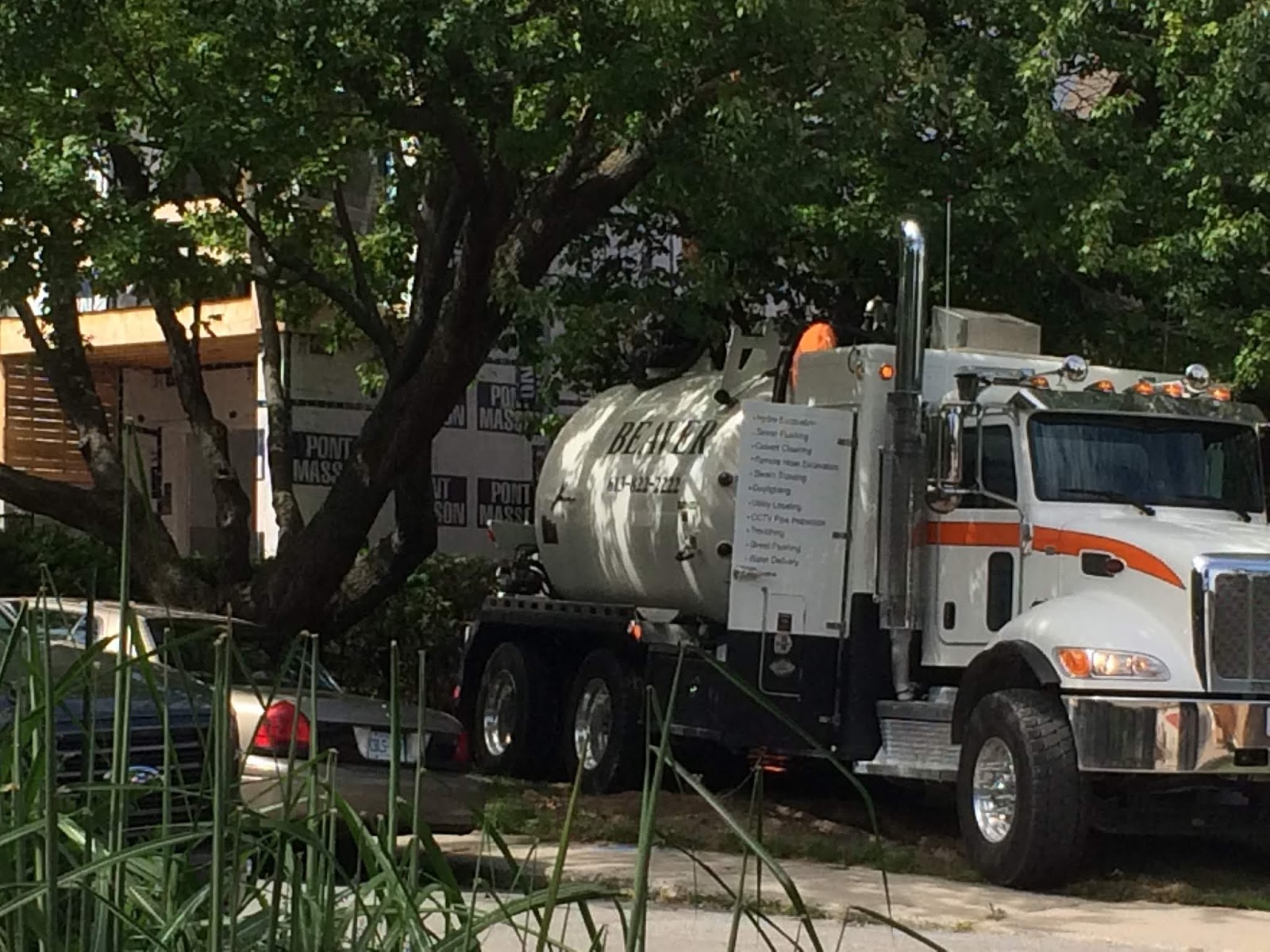
The absolute worst day of the summer was the day we endured this particular procedure. Workers parked their vehicle on the lawn of the lovely house (#77) awaiting demolition and ran a hose out to the backyard. When asked, they told me they were removing fill from the back yard at 79. This was accomplished, not with your old fashioned digging but by sucking the dirt out with this truck/hose contraption. The noise was horrific, absolutely horrific. Inside our house, with all the windows closed, you could not hear yourself think. It went on all day long.


The house across from us (#73) has been under construction since May of 2018. It is their landscaping that dragged on so long. It wasn't the owners' fault. There were problems with the wrong materials being ordered, a change in design for the back yard etc. For most of the summer we looked at this.

The landscaping was finally finished sometime in September. Last week there was a cement truck and other equipment there, to repair the sidewalk in front of the house. They have replaced a couple of sections of sidewalk but there are more damaged sections to be replaced. Apparently developers have to pay for the sidewalk sections that they damage. The city will be back to replace the other sections at a later date.

With the landscaping finally complete at # 73, we can be thankful that project is finished. However the doubles at #79 are nowhere near the finish line. There are always trucks there, with workers coming and going.
Here's the worst thought of all. There is no end in sight. Even when they finally finish # 79, we have two other properties on our block to go through the same horrible process.
However, here on Kenora Street it was business as usual. Most days there were maybe ten or twelve trucks and pieces of construction equipment parked up and down the street.
 |
| A typical summer day. On the right is the landscaping job at #73. The street is blocked off because of the work at #79. |
 |
| This view of the commotion at #79 shows the tree at #77. That's the tree that we'd love to save, but we'll probably be told it is too damaged to keep. It looks pretty healthy to us and hides a multitude of sins. |
Many days we felt trapped in our own home. It would have been pleasant to sit or perhaps even nap on the verandah, on those perfect summer days. However, we often stayed inside, with the windows closed, become of the ongoing construction chaos. It's not that they tore down the next two houses, slated for demolition this summer. No, instead we endured the exceedingly slow progress of the two projects at #79 and #73.
It's hard to say which aspect of living in a construction zone that I mind the most:
1. the hassle of having large vehicles all over the street, often blocking driveways,
2. the dust and dirt that blows everywhere
3. the workers who sometimes leave garbage around
4. the cement that was allowed to flow down our street
5. the NOISE !
I'd have to say it's the noise. That's the worst. There are different noises every day. As I write this, someone is loading heavy metal objects into a truck, resulting in loud, jarring, clanging smashes.
Believe me, if there is a noisy way to do something, these guys will do it. Remember the old days when you would shovel dirt into a wheelbarrow? Gone. Now you have to listen to a mini excavator that beeps constantly, as it scrapes across the pavement to load the wheelbarrow, one painstaking load at a time.
The absolute worst day of the summer was the day we endured this particular procedure. Workers parked their vehicle on the lawn of the lovely house (#77) awaiting demolition and ran a hose out to the backyard. When asked, they told me they were removing fill from the back yard at 79. This was accomplished, not with your old fashioned digging but by sucking the dirt out with this truck/hose contraption. The noise was horrific, absolutely horrific. Inside our house, with all the windows closed, you could not hear yourself think. It went on all day long.

The house across from us (#73) has been under construction since May of 2018. It is their landscaping that dragged on so long. It wasn't the owners' fault. There were problems with the wrong materials being ordered, a change in design for the back yard etc. For most of the summer we looked at this.

The landscaping was finally finished sometime in September. Last week there was a cement truck and other equipment there, to repair the sidewalk in front of the house. They have replaced a couple of sections of sidewalk but there are more damaged sections to be replaced. Apparently developers have to pay for the sidewalk sections that they damage. The city will be back to replace the other sections at a later date.

With the landscaping finally complete at # 73, we can be thankful that project is finished. However the doubles at #79 are nowhere near the finish line. There are always trucks there, with workers coming and going.
Here's the worst thought of all. There is no end in sight. Even when they finally finish # 79, we have two other properties on our block to go through the same horrible process.
Subscribe to:
Comments (Atom)