maryellenkot.ca
kotmaryellen@gmail.com

Friday, 11 May 2018

Talking about Dying


It's been six weeks since Dad died. As we settle into our new reality, I often relive his last weeks. I've been thinking about how the medical community deals, or doesn't deal with the very idea of dying. Historically, physicians have been  trained to save lives, not to guide patients and their families through the death experience.

As usual, it was a CBC radio program that prompted this recent examination. On Brian Goldman's show, White Coat Black Art,  (May 5) he interviewed a couple of young mothers about the deaths of their children. They belong to a group called One More Thing, as in, doctors often propose yet one more thing that could be tried, to extend the life of a medically fragile child.

The promo for the show reads, "We need to talk about death, say parents of children with life-limiting illnesses. Parents question why the medical system doesn't include death in their conversations with families, particularly those with medically fragile children."  Click here to listen to the show.

Much of what those young parents said, about wanting more honest discussion and preparation for the deaths of their children, could be applied to patients and families of all ages. It would help a great deal if doctors would give their honest assessment. If a professional told you up front, that your loved one was probably not going to live much longer, then everything would change. You could stop the fight to try one more thing, to beat whatever illness you were battling. If that news was delivered honestly and carefully to all family members, then they could work together more easily to comfort their loved one. If the patient heard that news, then he or she would have a chance to come to terms with the diagnosis; they might come to some kind of acceptance and be ready to make the most of their remaining time.

To be fair, a doctor friend told me that "it is always harder to predict prognosis in non-cancer patients". Dad was spared a diagnosis of cancer. He never had to endure excruciating pain or a myriad of side effects from chemotherapy or radiation. However, if cancer has anything positive to offer, it may be that impending death is sometimes easier to predict.  Many years ago a friend of mine spoke about the "gift of time" that cancer gives. In her case, she and her family knew that her mother was going to die from her cancer. They used her last months to spend quality time together, to plan, to reminisce, to enjoy each other's company.

I realize that the decision about whether to keep pursuing more possible medical intervention or to accept the approach of death, is one of the most difficult and profound of decisions. This is not a simple, straightforward task. Of course, we don't want to say goodbye to our loved ones. We want them forever. But at some point we are not doing them any favours when we deny the facts that may be right in front of us.

On the Friday before my father's death, we went to a lot of trouble to bundle him up and have him transported to an appointment with a specialist. That doctor said he was not concerned with the diagnosis of pulmonary fibrosis. He said it could take about a year for Dad to recover from his pneumonia. He gave him a requisition for an xray and told him to come back in six weeks.
Dad died the following Thursday.

I highly recommend having a nurse in the family. In our case we have two. They helped us to recognize that Dad was probably dying and didn't have much time left. He was eating less, sleeping more and becoming weaker by the day. We worked hard to have him followed by the local Palliative Care team. Fortunately, on Monday, palliative care doctors started coming to Dad and Mom's home, where we were caring for him. They were wonderful and gently guided us through Dad's last four days. We were very fortunate to be under their care.  Our daughter works in palliative care in Toronto. Her knowledge and insight were valuable as we travelled on that difficult journey. Dad died at home with many family members around his bed.

From our experience, I think that medical professionals would benefit from more training in the field of death and dying. On a local level, we realize how lucky we were. There are some areas of Ottawa that still have no access to palliative care. There's a lot of education and resources needed to improve the situation for dying patients, of all ages.

Sunday, 6 May 2018

Kitchissippi Times - Infill Housing

If you've been reading this blog for a while, you'll know how much infill housing drives me crazy. Here's an article I had in our community newspaper, The Kitchissippi Times, last October.


Dear Editor,

I just wanted to say how much I enjoyed reading the profile of Anne Hamilton who lives in a house on Princeton. (“Who Lives Here: The house with the white picket fence,” September 28 edition of KT.) In the piece, her home is described as “the little blue and white wooden house.” What a refreshing article! Here is a woman who declares, “I was looking for a home, not an investment.” This is, of course, in stark contrast to the vultures who roam our neighbourhoods now, in search of a property where they can tear down a perfectly fine home so they can build an unsightly double and make an enormous profit. I am also extremely tired of reading pieces in other papers where Homes articles extoll the features of gigantic new houses with master bedrooms as big as bowling alleys. No one needs that much space. Ms. Hamilton reminds us of the basics – that a house is a home. She has a “generous yard” which she can enjoy, she is in a good location so she can walk to retail shops. She is perfectly happy with a modest sized home.


“Unfortunately, even small homes are now priced way too high for many folks,”
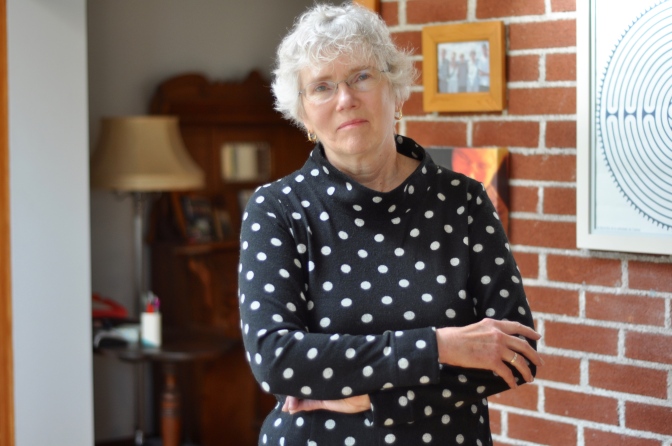
writes Mary Ellen Kot. Photo by Andrea Tomkins
“Unfortunately, even small homes are now priced way too high for many folks,” 
writes Mary Ellen Kot. Photo by Andrea Tomkins

The sad thing about this story is that she bought this place in 1991, when small houses were affordable.
Unfortunately, even small homes are now priced way too high for many folks. It’s the lot location that drives the price, not the house itself. And so we are losing most of our small homes; houses where many other residents would be as happy as Ms. Hamilton is now, and has been for many years.
Mary Ellen Kot,Wellington Village

......................................

May 9, 2018

The things is, now it's happening right across the street from us. In this case, I am resigned to the fact that this small house will come down. It's a tired old place which has had very little maintenance over the  years. It would take a tremendous amount of work and money to renovate it, to modern standards. 


However, I  remain concerned about what will be built in its place. I recently checked with our local councillor, to see how far Ottawa's new infill guidelines go. Are they designed to really protect the character of existing neighbourhoods? There are restrictions about the placement of front doors, parking spaces and garages. These have to match the houses on the block. By-laws dictate the height and front yard setbacks etc. As for building materials though -  anything goes. If you want to build a glass and corrugated steel box, in the middle of a block with brick homes with peaked roofs, that's not a problem. So while we await the bulldozers, we're very curious as to what we will be staring at from our front verandah.

On a sadder note, we recently heard that another small house on our block will go up for sale in the next week. Unlike the one across the street from us, this one is very attractive and well maintained. It's lovely. So will one person, or maybe a couple, decide it's their dream home and buy it? Or will it be a developer, who will knock it down and build for profit? 

What's really strange about all this, is that I'm getting used to it. I don't like what's happening but I'm resigned to the fact that our neighbourhoods are being transformed in this current culture of greed. 
ence


Saturday, 14 April 2018

My Dad

Most of you who read this, already know, but I will write it anyhow. My father, Stephen Donald Kot, died on March 29th. He was a wonderful father, husband, son, uncle, grandfather, great grandfather, and friend. Click here to read Dad's obituary as it appeared in The Ottawa Citizen and the Weyburn (Sask.) Review.


 Dad would not have wanted all the fuss but Wayne Scanlan of the Ottawa Citizen came to the house and interviewed us about Dad. By very happy coincidence, he appeared a half hour after Dad's teammate, Len Fluet, arrived at the house. Len had just cleared out Dad's locker at the curling club. How lucky was Dad, to be curling at 93! Click  here to read the lovely tribute that Waybe Scanlan wrote.

I was just looking through some old writing of mine and came across this piece that I wrote a few years ago. It will give you an idea of why we are going to miss Dad so much.

It is, of course, an understatement, but I will say it anyhow. As kids, we got lucky in the Dad department. First of all, he has always been a very supportive father to all of us and secondly, we have had him for so long.

At a dinner party a while ago I was telling some friends about a problem that came up at our house. It may have been when we had rats in the basement. I was in the middle if the story and I was saying, “ So I picked up the phone…” and a friend interrupted, “I know. You called your Dad.” 
“Of course I called my Dad”, I answered. “Who else am I going to call?”

That’s been the way we have always operated. For all kinds of issues, we have called Dad. Most of the time he has been able to help us to solve our problem of the day, whether his help has been long distance over the phone or in-person help. In the case of the rat problem, he came right over, set some traps, and helped that rat onto the hereafter.

It’s not just that Dad always helped us or did the work, on our homes and cars. What is possibly more important is that he taught us how to do some of that work. I am the least talented in those areas. Everyone else in the family is more talented than I am. However, even I am slightly inclined, because of all the time I have worked beside Dad.

A month ago Pat and I were having trouble with our garage door. The roller thing kept coming off the rail. Pat was working on it but nothing was working. I went out and looked at it for a bit and realized what the problem was. It wasn’t that hard to figure out. That’s because of being with Dad, watching how patient he is,  how he analyzes things, how he doesn’t  give up when things get difficult.

Love is a verb, not just a noun. Actions speak louder than words.

There are many ways to show love. Dad has always loved us with his actions. He has taken care of us. He has helped all of us out , wherever we have lived and whatever car or house we have been working on.

This week I’ve been with Pat at Norah and Sean’s place in Toronto. Aaron was there when Eliza was born. Just before he left to go back to Ottawa I asked Aaron to look at a couple of things at their house. One was their kitchen tap and the other was a bedroom door that was sticking. Aaron gave us advice and Pat and I were able to solve those 2 small problems. They were only small items but they will be appreciated. If we do small things to help out when we visit, it is because of Dad’s example. When Kath  and I lived out of town and Dad and Mom visited us, they never visited without Dad doing many jobs around our houses: putting in electrical outlets, doing some plumbing or carpentry.

And so we help out our kids and family because of Dad’s example. Although he wasn’t there in Toronto this week, really it is because of Dad that that bedroom door doesn’t stick anymore and the kitchen tap moves  more freely. Dad has spent countless hours working with Aaron, teaching him and teaching all of us. Besides that knowledge, he has more importantly, given us the example of using your talents to help others.

Tuesday, 27 March 2018

March

Why have a blog if you are not going to write regularly? How busy can a retired person really be?
As usual, I had the very best of intentions. First I was going to write about the death of Rebecca Schofield, and the remarkable impact she had on so many people. What a wonderful legacy she has left - to inspire random acts of kindness.

Then I was going to write about our Caribbean cruise; not just about the food and the pleasure of swimming in the ocean, but about the astounding good nature of the crew who served us on board. If there was an Olympic event for cheerfulness, smiling and helpfulness, the hard-working Filipino and Indonesian staff members on that ship would win the gold medal for sure. They could teach us all a lesson in how to treat people.

However, I have no time or energy to write about anything these days. For the past three weeks I have been accompanying my family on the most difficult of journeys. We are getting closer to the end now. My dear father is dying and my heart is breaking a little more every day.


Saturday, 3 February 2018

O Canada!!

Our five year old grandson loves to sing O Canada. When he was here at Christmas time we probably sang it at least a couple of times a day. He also loves to play teacher so Santa brought him his very own pointer for Christmas. Although his reading skills are still developing, he loves to stand at a wall and lead songs or poems from a wall chart.

I've been meaning to write out O Canada on chart paper for him, but haven't got around to it. One of my excuses was that I didn't know whether to use the new version or not. If I wrote "In all of us command" and tried to teach him that, it would be confusing for him, as they are no doubt using the old version at school.

Now, however that issue has been resolved. I was happy to learn that this week the Senate finally passed the bill which amends our national anthem. The Conservatives are angry that other members of the Senate found a way to pass this motion. Apparently eighteen months was not long enough to debate this big change of two words.

I'm especially pleased that we will never have to explain to our granddaughter why O Canada has (had) the words, "In all thy sons command."

Now if I could have everything my way, they would have also changed, "Our home and native land" to "Our home and chosen land" but you can't have everything. This change, to gender neutral wording, was more important. Thanks to the late MP, Mauril Belanger, for championing this cause.

Wednesday, 10 January 2018

Flashback to the Ice Storm of '98

For the past week, many folks in this area have been saying, "I can't believe it's been twenty years since the ice storm." The actual ice storm lasted from January 4 to 10th of 1998. The aftermath was a lot longer for many residents. One afternoon while we were without power, I sat in our family room and hand wrote a little piece about my observations of the storm, as it affected our family. My sister had power and a fax machine so I took it over to her place and faxed it to The Toronto Star to see if they might be interested. Lo and behold, they published it a couple of days later! It was my second published piece. 

All kinds of things have changed in twenty years. I don't think any newspaper would consider a handwritten offering today. What am I talking about? It is now so difficult to get freelance pieces published at all. How the publishing world has changed, with our tiny newspapers, and advertisers all online. 1998 was before laptops and cell phones and Google and Facebook. It was another era and not a bad one either.  

Our family did not endure any real hardship during the ice storm. We were lucky. Here is my humble offering, as it appeared in The Toronto Star on January 13, 1998.

Some good things from the ice storm          

"Here comes the sun, little darling. Here comes the sun, and I say . . . It's all right."

That wonderful old Beatles tune ran through my head when I woke up to sunshine streaming through my bedroom window Saturday morning. Here in ice-bound Ottawa, it really does seem like "it's been a long, cold lonely winter" although we're only at the start of January.

Our family hasn't been hit hard, as have those in Montreal or in rural areas. Compared to many, the past week has presented us with only minor inconveniences. On Thursday we lost our power for five hours and Friday it was out for six hours. During our brief blackouts, as we have struggled with everyday household tasks, I have learned some new lessons and re-learned some old ones.

Electricity is a good thing, but maybe we rely on it too much.

Even a little power is a good thing. My parents are experiencing a partial blackout. They have heat, one TV, some lights and outlets in some rooms, the fridge, and a very weak stove. Mom says that as long as they have a furnace and a fridge they'll be fine.

Knowing someone who has power when you don't is a good thing. On Thursday night we finished cooking dinner in our neighbour's oven.

Winter days really are short! Friday, we decided that since we were stuck inside we would take down the Christmas tree. About 3:30 p.m. I looked around the living room and realized that we were starting to lose light and by 4:30 the room was almost dark. A power outage in summer wouldn't be that bad, would it?

Kids adapt to a power outage just fine if their friends live close by. On the other hand, teens don't find days at home with parents to be very cool.

Boys operate toilets better in lit rather than dark bathrooms - enough said!

Candles are wonderful! You can do a lot of things by candlelight. Our 12-year-old was not thrilled when his dad insisted that he could practise piano the other night. He was happier when he and his friends took the candles to the basement and had a great game of candlelight ping-pong.

Gas is good. Although a gas furnace will not operate in a power outage, a gas hot water heater will. (There's another candlelight activity for you.) Some powerless people with gas fireplaces have ended up with a few families camped out in their living room. A gas barbecue outside is a good idea.

Be prepared. It is a far better thing for every good Canadian to keep a supply of salt, matches, candles, flashlights and batteries than to risk life, limb and lineups driving to Canadian Tire stores in an ice storm.

It's the old trees that go first in an ice storm. I really thought that the small trees would bend first but, no, it's the older, taller ones that have been destroyed by the weight of the ice. It is awful to lie in bed and hear the same sequence of sounds over and over; a tearing, ripping and sometimes snapping sound as the limb separates from the tree, followed by a crash as it hits the car, garage, house or ice-covered snow below it.

There are always people in much worse situations than ourselves. When our power came back on last night we watched the news. As we learned that many in Montreal have lost drinking water as well as power, as we listened to owners of Christmas tree farms and sugar bushes cry, we knew that we were indeed very fortunate. We have absolutely nothing to complain about and much to be grateful for.

Monday, 18 December 2017

Still sexist after all these years


There are days when you just wonder - really, are we still engaged in these same struggles? That thought came to mind today while listening to CBC radio's The Current. Click here to listen to their item on gender-specific toys for children. It's an interesting discussion about how boys, girls and parents choose toys and what part marketing plays in those decisions.

Here's an example for you. I took these photos at an upscale children's store. The actual toy idea is an old fashioned concept - lacing cards. Now you would think that you could simply have one set of cards that would be appropriate for all children. But no, this manufacturer felt it necessary to make one set for boys and another set for girls.


The boys' pictures illustrate great options - superhero, firefighter,  cowboy, pirate or astronaut.

However the "girly" girls only have one active option - a superhero.
Wow, they can twirl!
Daydream - now that's ambitious!
Maybe this is the girls' version of astronaut?
Really - this is all they could think of for girls?
What would recently retired Chief Justice of Canada Beverley McLachlin think of these options?

Today's radio discussion got me thinking about the time I spent at Queen's University's Faculty of Education. It was a year (1975-76) that changed me.That was the year of my engagement, the year that I realized  I didn't have to change my name when I got married. 

Besides engaging in name-changing discussions with classmates and profs,  I took a course about sex role stereotyping in the classroom. It's a subject I had never thought of before. Maybe that's because sex role stereotyping is so subtle and yet so pervasive. It can be a simple statement like, "Can I have a couple of strong boys to help me move these desks, carry these books, etc." Right away the teacher sends out the message that boys are stronger than girls.

Another course that changed me was outdoor ed. I had camped with my family as a kid but I had never been as physically challenged as I was in that course. I'll never forget the day our instructor told us that the guys would carry the canoes on the portage while the women would double pack. I could barely manage to carry my own pack on my back but now I was expected to carry one of the guys' packs in front, at the same time! The old Mary Ellen, the one who had grown up in a house of 4 girls playing with dolls - that Mary Ellen thought she would expire on the spot. It was empowering to realize that my body was totally capable of carrying such a heavy load.

One of the best teaching tools I picked up that year was a terrific music album called Free to Be You and Me by Marlo Thomas. It features Harry Belafonte singing Parents are People, Alan Alda with William's Doll, NFL football star Rosey Grier with It's All Right to Cry, among a great group of songs and stories. Over the years I often used that in the classroom. It helps that the songs are funny, with catchy tunes. However what is much more important is the non - sexist message, the important life lessons. I highly recommend this album for teachers and parents. It's still very relevant and (unfortunately) necessary today.

Maybe it's time for me to pull it out for my grandchildren.